Before Mesh
Council faces a big decision too early.
The building has to decide whether to pursue major electrical work before knowing how many owners will actually install chargers.
An existing Vancouver townhouse strata needed a credible electrification path without starting from a major civil/electrical infrastructure project.
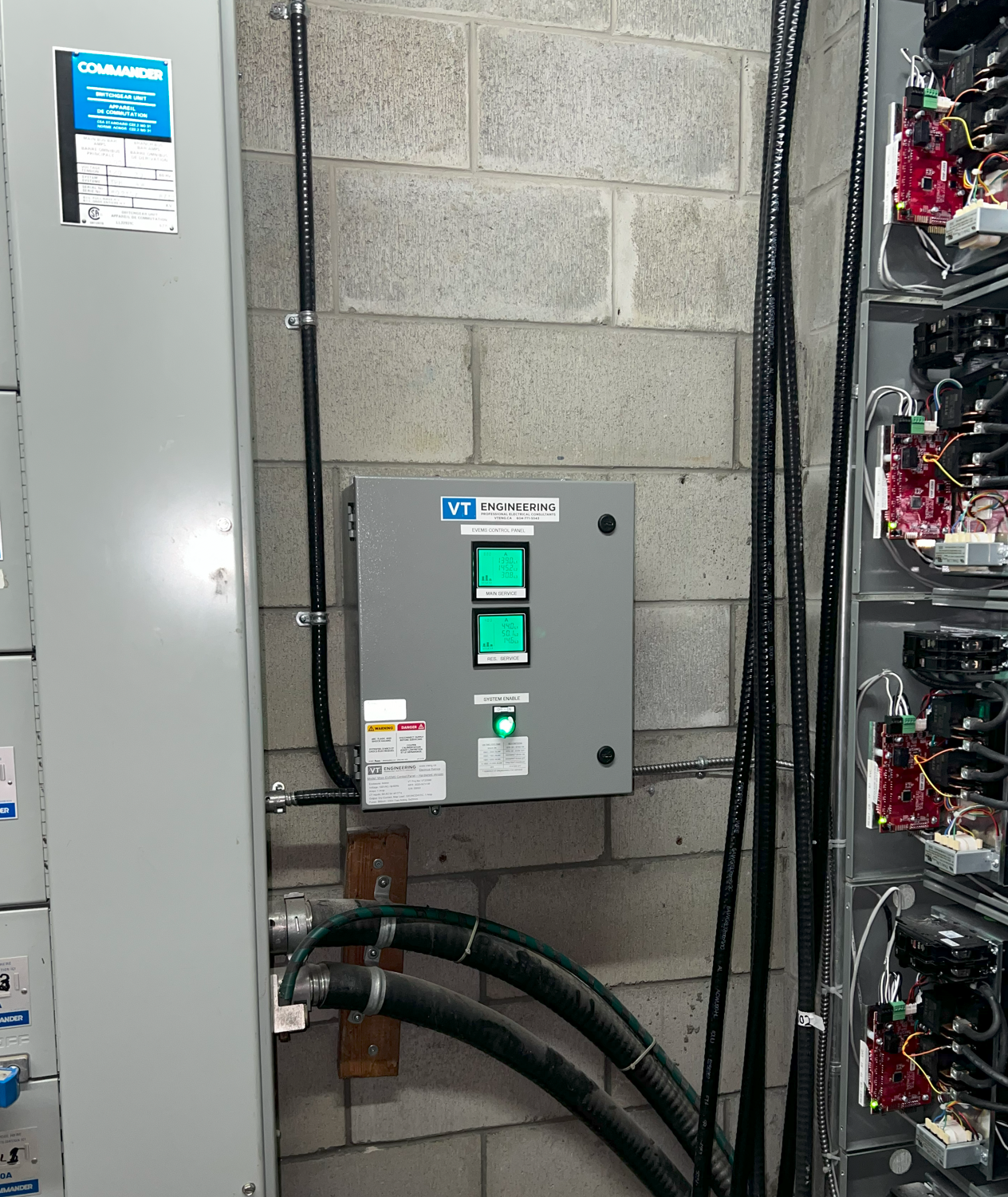
VT Engineering EVEMS installation context.
Welwyn is strongest as a council example because it shows how a constrained townhouse site can move from a vague service-upgrade fear to a specific common-layer decision.
The approval path had to work across a real multi-unit townhouse site, not a single-panel demonstration.
Retrofit complexity made a common control decision more practical than treating every future charger as a separate negotiation.
The electrical question was shared capacity management first, then owner chargers after the common layer was understood.
Council could separate the common Core layer from each owner's Leaf, charger, and stall work.
Like many townhouse stratas, Welwyn had private owner needs sitting behind shared electrical limits. A conventional path can quickly become a broad infrastructure project: new wiring routes, service-upgrade assumptions, utility timing, and a difficult owner vote before demand is proven.
The building has to decide whether to pursue major electrical work before knowing how many owners will actually install chargers.
The Core manages the shared constraint. Owners add Leaf units and chargers later, when they are ready, without re-opening the building-wide decision every time.
The product value is not just load management. It is that the technical architecture supports a decision model council can explain: shared safety layer first, individual owner participation later.
The problem was framed as a building-capacity decision, not a charger-brand decision.
Council could evaluate one managed common layer before every owner needed a charger.
Owners could opt in later with their own Leaf, charger, and stall work.
Wireless controls reduced dependence on new communications wiring through existing buildings.
Local fail-safe load management kept the safety function independent of resident Wi-Fi or a charger cloud.
Where the shared service or transformer constraints actually are
Whether CT access and controller placement are practical
How owner stalls, garage panels, and future charger requests should be grouped
Whether a service upgrade is truly required now or can be deferred for a suitable site
What council can circulate before asking owners to vote
Send the address, building type, unit or stall count, and current EV demand. VT Engineering will tell you what to verify next.
Review my building