How Mesh works
Most buildings have electrical headroom most of the time. Mesh makes that capacity usable by measuring demand, sharing turns fairly, and keeping every managed load inside the approved envelope.
Mesh turns unused electrical headroom into usable capacity.
Existing buildings are not maxed out every minute. The problem is that unmanaged chargers must be treated as if they could all run at once. Mesh measures the real load, confirms available headroom, and shares that headroom across eligible loads without letting any service entrance or feeder exceed its configured limit.
Main and feeder CTs show real demand and usable headroom.
The Core turns measured headroom into a safe load budget.
Long waits and long run times are shared over time.
Commands are sent locally, no charger cloud required.
Each Leaf applies the allowed, stepped, or paused state.
What the Core does
The Core lives in your building's electrical room and watches how much electricity the building and each monitored feeder are using. When capacity gets tight, it does not treat every owner the same at the same instant. It curtails an eligible group where the constraint exists, rotates long waits and long run times fairly, and restores one group at a time when capacity returns.
What the Leaf does
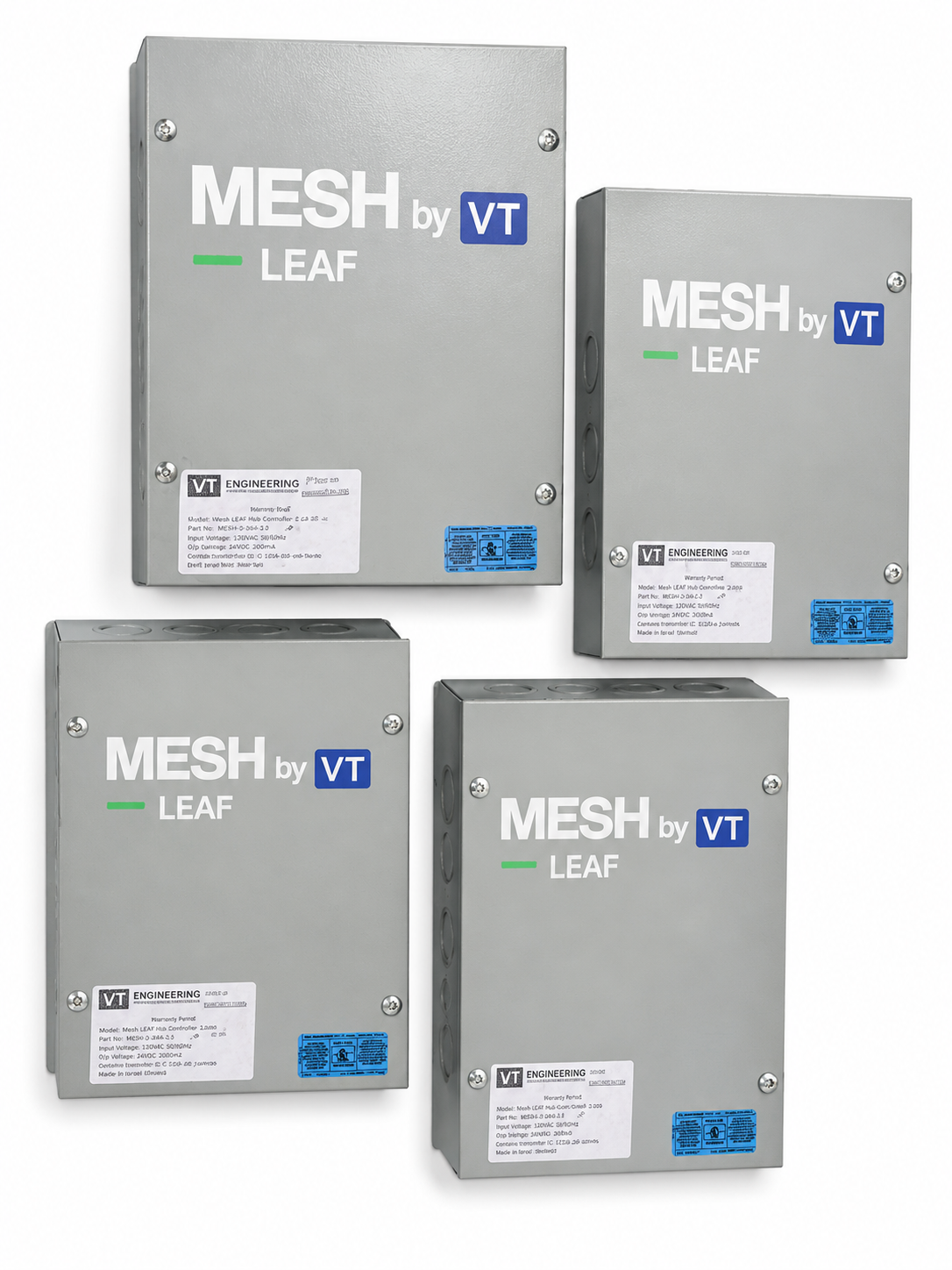
The Leaf is a small device installed between the electrical panel and the EV charger or other configured flexible load. It receives instructions from the Core over a local radio signal, with no Wi-Fi, internet connection, or cellular contract required. The charger itself is unchanged; the Leaf applies the allowed, reduced, or paused state the Core has assigned.
A managed-capacity layer between the electrical room and each charger.
The site footage shows the same practical pieces Mesh depends on: owner-side charging hardware, an electrical-room controller, CT-monitored panels, and local control hardware. Mesh updates the product language to Core and Leaf, but the operating idea is the same: use measured headroom and step only eligible loads when capacity gets tight.
Open the VT Engineering EVEMS page →What "load management" actually means
Your building has an electrical service: a maximum amount of electricity it can draw at one time. The building rarely uses that full amount, so there is often spare capacity sitting unused during the day and overnight.
The catch is approval. Without load management, new EV chargers have to be treated like they might all run at full power at the same time. That can make the paper calculation fail even when the building has plenty of real-world headroom most hours.
Load management means Mesh watches the actual draw and turns that headroom into controlled capacity. In practice, one group may pause or step down while another keeps running, then the system rotates the next turn to the group that has waited longest. The building gets more useful charging access without pretending every owner plugs in at full power at the same moment.
Resident version: Mesh uses the capacity the building already has, shares it fairly, and steps in only when the electrical room is getting close to its limit.
Works in more than just strata townhouses
Mesh is designed for any building where multiple electrical loads share a constrained service — and where running new wiring between them isn't practical.
See an actual install
Confirm CT access, panel condition, radio path, and stall layout.
Mount Core in the electrical room and commission service monitoring.
Install a Leaf with the EVSE when an owner is ready to charge.
Are you an electrician?
Load-management logic, failure modes, CEC compliance, spec sheets, and installer program.